More places
More places bring new needs, capabilities and delivery settings.
Urdu, Pashto, Dari, Persian, Nepali, Sinhala, Dzongkha and Dhivehi have complete 149-key AI translation review drafts, with A3, paired A4, single A4, card and guide formats. Nine country entries link twelve national entry languages and individual business worksheets. Existing Indian language extensions continue in the same register.
Open South Asia →Hindi, Bengali, Marathi, Telugu, Kiswahili, Hausa, Yoruba and Amharic now have complete 149-key AI translation review drafts with A3, paired A4, single A4, card and guide formats. Follow the remaining language scope and 28 blank translation handoffs in the shared register.
Choose a local-language entry →Explore three existing shared editions, 37 source-locked translation handoffs and six country business worksheets for MERCOSUR. Venezuela is recorded separately as suspended; Bolivia has an accession transition. Professional review and owner acceptance are tracked separately.
Browse by language or country →Explore the Arabic national written edition, English operational reference and six country business annexes for GCC. Professional review and owner acceptance are tracked separately.
Browse by language or country →Explore 13 written editions and 11 country business annexes for ASEAN. New translations are AI review drafts; professional review and owner acceptance are tracked separately.
Browse by language or country →Explore 26 written editions and 27 country business annexes for the European Union. New translations are AI review drafts; professional review and owner acceptance are tracked separately.
Browse by language or country →Explore 28 written editions across 29 countries. New translations are AI review drafts; professional review and owner acceptance are tracked separately.
Browse by language or country →C0-005 · English · 2026-11-19
Global capability. Local outcomes. Shared progress.
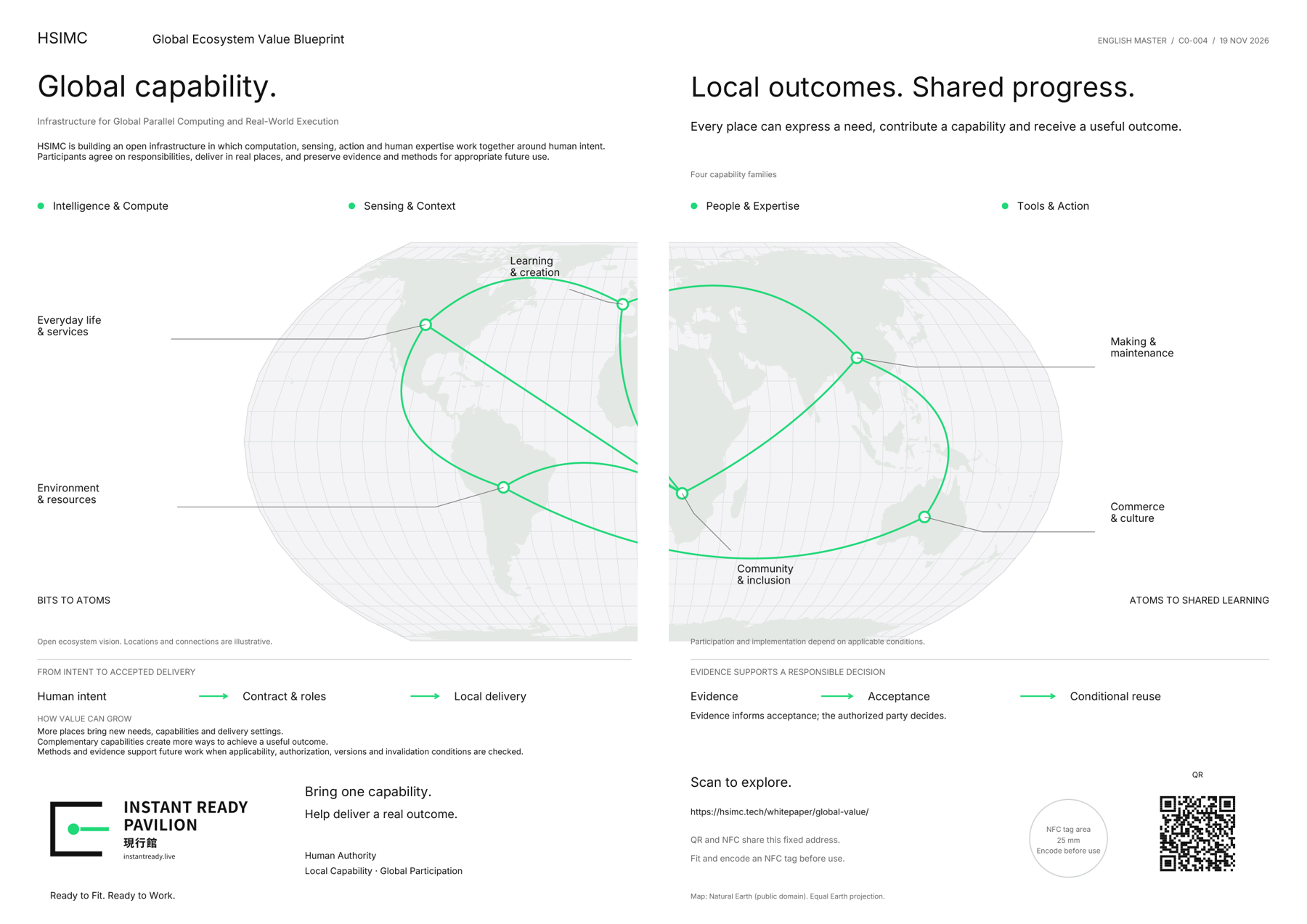
HSIMC is building an open infrastructure in which computation, sensing, action and human expertise work together around human intent. Participants agree on responsibilities, deliver in real places, and preserve evidence and methods for appropriate future use.
Every place can express a need, contribute a capability and receive a useful outcome.
Based on the C0-004 English semantic master. Fixed language edition
C0-006 · APEC member-economy language expansion
Explore 10 new written print editions, separate Māori and Tok Pisin REVIEW DRAFTS, and a complete Hiri Motu translation handoff. Existing language editions remain available above.
Open the APEC print downloads and coverage index →
Independent professional native-language review remains pending for the new localizations. This collection does not cover every legally recognized, regional or sign language.
WHAT PARTICIPANTS CAN CONTRIBUTE
Computation, observations, professional judgment and physical work can contribute to the same task. Individuals, small businesses, schools, communities and larger organizations can offer a capability, request support, or take several roles.
VALUE WHERE PEOPLE LIVE AND WORK
These domains create opportunities for economic and social value: useful services, learning, participation, cultural understanding and responsible resource use. The value must be demonstrated through actual outcomes.
A SHARED STRUCTURE FOR COLLABORATION
An intent describes the desired outcome and its constraints. A contract records responsibilities, authorization, inputs, handoffs, deliverables and acceptance criteria. Participants carry out the agreed work and connect each delivery to its evidence. Evidence records relevant sources, conditions, processes and results. The authorized party reviews the specified object and version, then accepts it, requests changes or commissions further work. Acceptance remains a decision with a responsible party. Here, contract means the agreement organizing the work; each implementation determines its appropriate commercial and legal form.
EXPANSION, COMBINATION AND ACCUMULATION
More places bring new needs, capabilities and delivery settings.
Complementary capabilities create more ways to achieve a useful outcome.
Methods and evidence support future work when applicability, authorization, versions and invalidation conditions are checked.
More places can bring new needs and delivery settings. More capabilities can enable new combinations. Completed work can leave methods, components and evidence that help later work. Reuse requires checking applicability, authorization, the current object and version, and conditions that would invalidate earlier findings. Further validation is arranged when needed. This creates a basis for cumulative value; its practical value depends on real demand, available capabilities, local conditions and workable delivery economics.
PRINT EDITION
A single-sided global blueprint for display and discussion.
A self-contained one-page summary with the same continuing entry.
A card-sized invitation with a printed QR and a reserved NFC position.
Print at actual size (100%). Follow the assembly guide for joining the two A4 sheets. A printed NFC mark reserves the position for a physical tag; encoding and tap verification are separate steps.
English is the semantic master. These translations have undergone semantic consistency and layout checks; independent professional language review is pending.
Human Authority · Local Capability · Global Participation
Describe the outcome your capability can support, its conditions, and how you can participate and deliver.

Discover capabilities and next steps with InstantReady.
Explore InstantReady
QR encodes the address shown here.
GENAI NATIVE DOCUMENT · URL → QR → COPY → PRINT → NFC
QR and URL are ready. NFC writing starts only when you choose it.
Write this URL as an NDEF URI record, then tap the tag independently to verify it. Sharing an address does not grant execution authority.