Safety, interchangeability and test
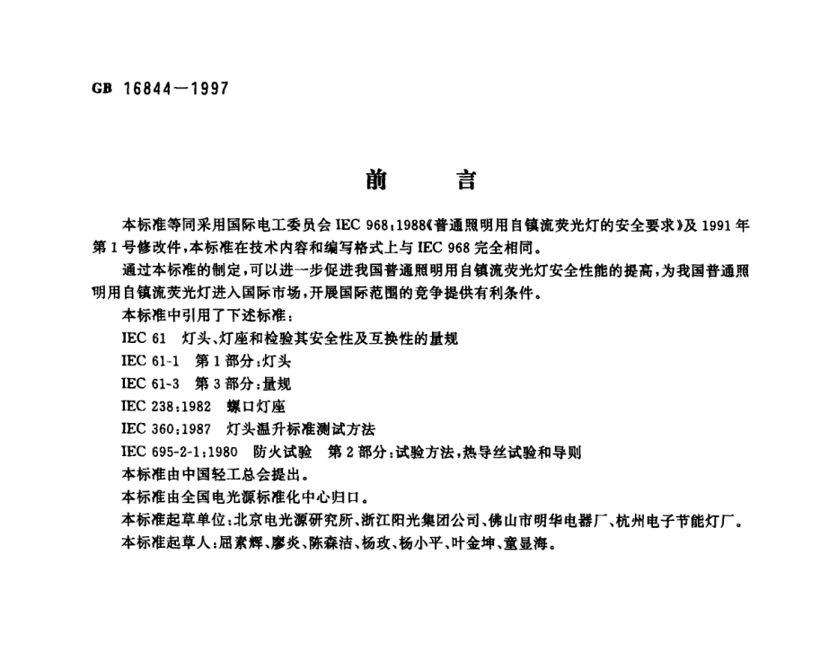
The foreword of GB 16844—1997, Self-ballasted lamps for general lighting services—Safety requirements, names Liao Yan as one of the drafters. It adopts IEC 968:1988 and its 1991 amendment. [S05]
HSIMC-INITIATED · C0-002 · LIVING WHITE PAPER
InstantReady Infrastructure for the Ten-Billion-Phone Opportunity
HSIMC-initiated. Grounded in three real company-linked pathways, a documented engineering lineage and eight founder-accessible launch locations.
从已有设备到可授权的现实生产力。以创始人工程脉络、三家真实公司的应用路径与香港—深圳八处可接入场所,建立可持续完善的白皮书。
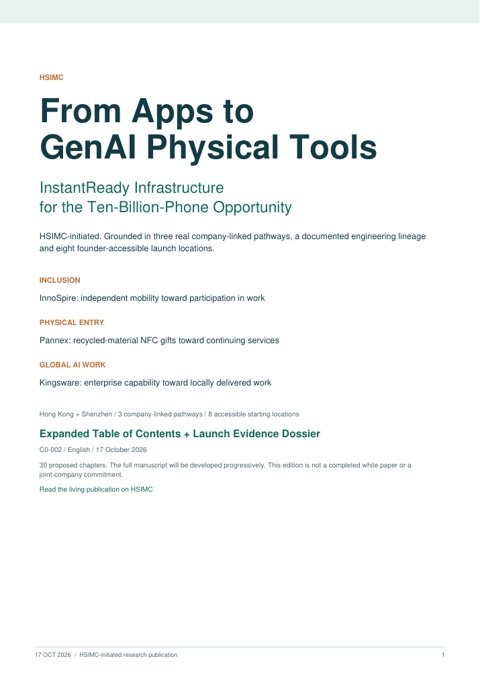
GLOBAL LANGUAGE EDITION · C0-003-6L
同一项工作议程,六种语言平等接入。每版保留完整的 30 章、147 个小节、9 个部分和 9 个附录;各提供 12 页 PDF、在线预览、搜索及打印。
Independent HSIMC research translations using the six official UN languages; not a UN publication or endorsement. Complete TOC and core framing, not the full manuscript. The original 21-page English C0-002 evidence dossier below is preserved unchanged.
THE PROPOSITION
Activating a phone creates both useful capability and new, context-specific demand. HSIMC forms the missing tools, resources, environments, permissions and supervised work so that intent can become an accepted result.
The contribution is not another general-purpose phone-control app. It is a proposed production infrastructure connecting existing devices and industrial knowledge to useful, locally delivered work. Traditional manufacturing and channels remain assets; GenAI and MCP create new ways to compose and consume what they can supply.
The economic proposition is to make new work feasible: wider participation through accessible tools; continuing services through physical products; and enterprise AI capability delivered where the work actually occurs. Value should be tested through accepted outcomes, contribution, cost and continued usefulness—not assumed from device counts.
Expanded TOC and launch evidence dossier. Not a completed 30-chapter manuscript. Core Chapters 1–22 are retained from C0-001; Chapters 23–30 add the three company pathways, founder evidence and Hong Kong–Shenzhen launch network.
The title uses the upper end of GSMA’s cited 5–10 billion dormant-phone estimate. It does not claim ten billion compatible smartphones or ready MCP servers. HSIMC’s 356,782 reference identities are addressable records, not the same number of active executable services. [S02, S03]
This is an HSIMC-initiated publication. Founder influence, physical access, commercial licences, certification scope and institutional programmes are separate facts. No joint venture, sponsorship or institution-wide authority is inferred.
ABOUT THE FOUNDER
Engineering credibility, built across standards, physical products and global work.
Founder, HSIMC. The supplied business cards identify Benny Liao as Chief Digital Officer at Pannex Scien and Strategic Execution Architect at InnoSpire Technology Limited. These roles do not imply ownership or executive control of all three companies. [S09]
The foreword of GB 16844—1997, Self-ballasted lamps for general lighting services—Safety requirements, names Liao Yan as one of the drafters. It adopts IEC 968:1988 and its 1991 amendment. [S05]
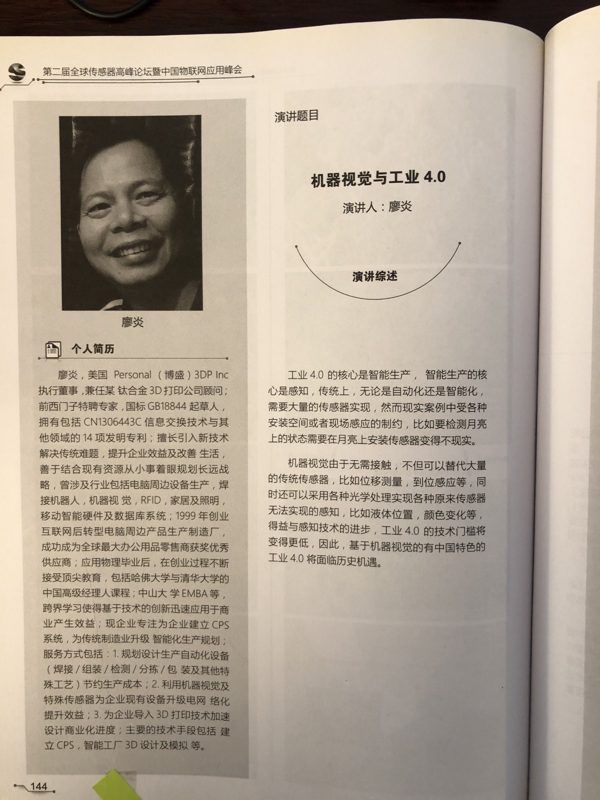
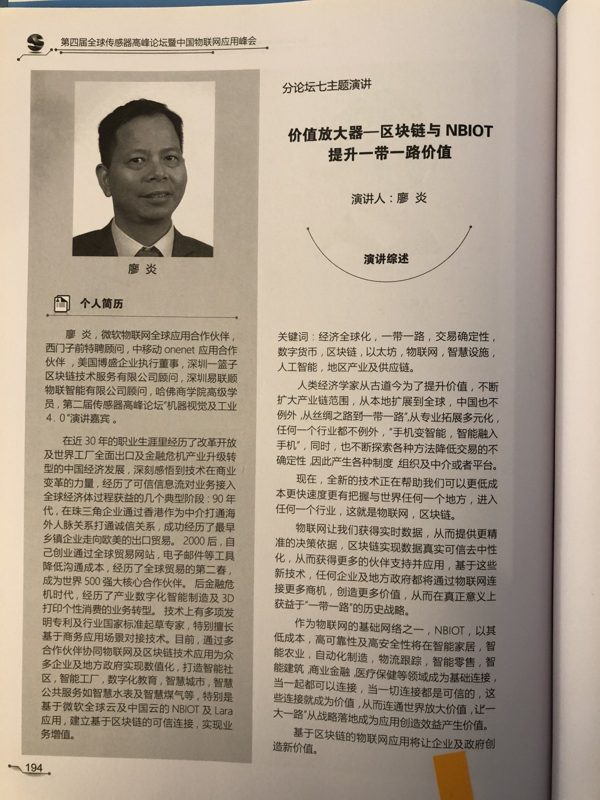
The supplied Beijing proceedings record Machine Vision and Industry 4.0 at the 2nd Global Sensor Summit & China IoT Application Summit, 28 August 2015. This is the source’s formal event title. [S06]
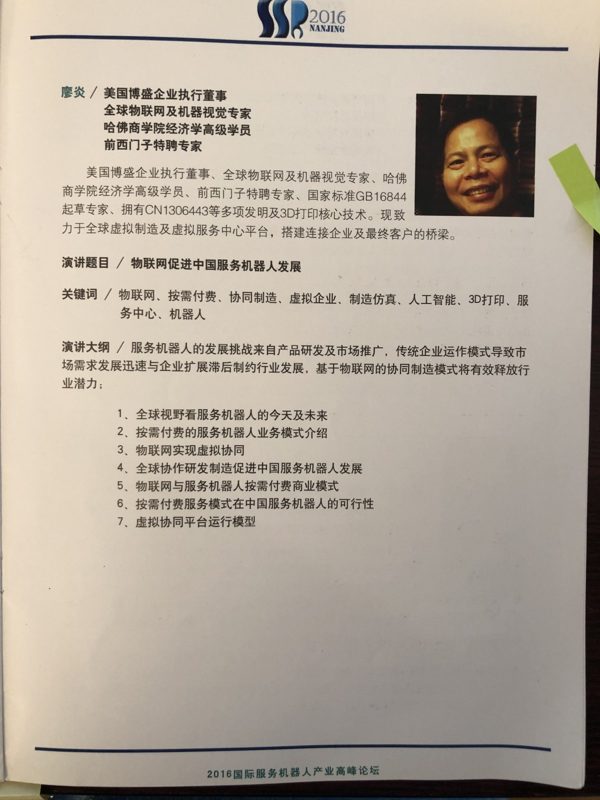
The Nanjing program, 10 September 2016, records a talk on the IoT and the development of service robots in China, including pay-as-you-go and collaborative service themes. [S07]
The Chengdu proceedings, 31 August–1 September 2017, record a talk concerning blockchain, NB-IoT and value along the Belt and Road. These are historical research themes, not claims of deployed modern MCP capability. [S08]
The Sony research trail links installation, NFC, USB vision, permissioned MCP battery access and human-operated revocation. Public Runtime addressability and physical acceptance remain separate measures. [S02, S19]
The theoretical thread is an engineering interpretation: interfaces make components interoperable; explicit conditions make capability usable; scoped authority makes work permissible; tests and human acceptance make results dependable; continuity makes learning transferable. Historical credentials support the lineage, not a claim that the proposed architecture is already proven at global scale.
THREE REAL COMPANY-LINKED PATHWAYS
These are HSIMC-initiated pathways grounded in existing companies and founder-described relationships. They are not three already-contracted programmes.
01 / INCLUSIVE PRODUCTIVITY
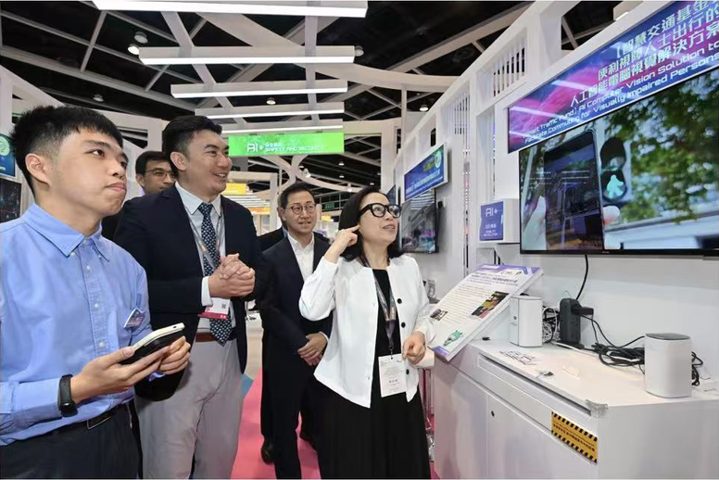
Existing foundation. InnoSpire’s official site describes visual-assistance apps and smart glasses. CityU lists the company under HK Tech 300 Angel Fund start-ups. The supplied role card connects the founder to InnoSpire as Strategic Execution Architect. [S09–S11]
Evidence and current position. The Hong Kong Government’s 13 April 2026 release describes AI computer-vision glasses helping people with visual impairments identify obstacles, bus stops, roads and pavements, with navigation functions. The company’s mobility work is a real starting context; workplace participation is the next proposed extension, not an already-verified employment outcome. [S12]
Proposed extension. Combine a person’s chosen phone or glasses, accessible prompts, local human support and a bounded e-Person task role. The person remains the decision-maker and can be a paid contributor, colleague or customer—not merely a passive assistance recipient.
First Work to validate. Co-design one supervised information task, such as obtaining an item label, checking a prepared record or contributing an accessible explanation. Test it first in a controlled setting; do not turn an unvalidated AI response into sole navigation or hazard-avoidance authority.
Acceptance. The participant can understand and revoke consent, perform or supervise the task, correct errors and receive an accepted result. Record task completion, error recovery, accessibility and fair contribution terms; do not infer income or mobility safety from a demo.
User agency and participation + accessible work design + local training/support + reusable assistive capabilities.
Company-linked pathway initiated by HSIMC. Institutional listings and the government event do not constitute endorsement of this paper or a joint programme agreement.
02 / PHYSICAL ENTRY & CONTINUING SERVICES
Existing foundation. Pannex Scien publicly describes corporate gifts, NFC, recycled materials and operations spanning Mainland China, Hong Kong and Thailand. The founder’s business card states Chief Digital Officer; frontline global customer relationships are founder-reported. [S09, S13]
Evidence and current position. The founder confirms Pannex authorization to manufacture and sell FIFA Women’s World Cup 2027 licensed gifts within approved categories and territories. The earlier supplied catalogue is titled Official Licensed Product Mobile Accessories Catalog. The underlying licence and its schedules have not been independently inspected in this edition. [S14]
Proposed extension. Retain the object’s established product and branding value, then make NFC an owner-controlled entry to useful information and services: instructions, accessible product guidance, authorized support, evidence-backed content and commissioned tasks. A service may change while the physical gift remains useful.
First Work to validate. Use one approved NFC-enabled sample to open a versioned, rights-cleared product page; let the user request one bounded service; route authorized work through HSIMC and return an accepted answer with provenance. Existing distributors can sell a familiar product without becoming system administrators.
Acceptance. Verify the tag destination, content owner, versions, language, consent and service result. Track product economics separately from digital-content maintenance and task delivery. NFC UID is not e-Person identity; a tap is not a grant.
Manufacturing and channel value + longer-lived customer usefulness + new content/service work + contributors paid for accepted outcomes.
GRS claims apply only where covered by valid product/transaction evidence. Pannex’s merchandise rights do not automatically license new AI content, mark use, HSIMC services or global territories.
03 / GLOBAL AI WORK DELIVERY
Existing foundation. Kingsware describes AI digital-employee and enterprise-agent solutions combining AI, large models and RPA. The founder reports a longstanding relationship through which detailed strategic work can be developed. The capability base is real; this proposed HSIMC programme is not presented as a signed partnership. [S15, S18]
Evidence and current position. The strategic question is what must exist overseas for useful work to be delivered: a local place, an authorized interface, a responsible operator, accepted output, support and continuity. Software capability and overseas operating readiness are different contributions.
Proposed extension. HSIMC proposes local work formation and governance around separately supplied enterprise capabilities. e-Person maintains the working identity and responsibility context; the software provider contributes the scoped capability; local operators provide the necessary Reality. Models and providers remain replaceable under the work contract.
First Work to validate. Define one cross-border service brief with an identified buyer, a local delivery host and a bounded digital task. Assess the relevant Kingsware interface and commercial terms before committing execution. Record software, device, site and supervision contributions separately.
Acceptance. Confirm the counterparty’s agreement, execution authority, support responsibility, accepted output and payment basis. A product demonstration or referral is not evidence of global service operation.
Enterprise software reaches real delivery conditions; local participants earn from useful work; HSIMC is paid for formed and maintained operating capability, not a generic reseller label.
No claim of rescue, free corporate transformation, exclusive control or committed investment. Strategic non-cash/deferred contributions, where pursued, require staged agreements and valuation/acceptance evidence.
HONG KONG + SHENZHEN
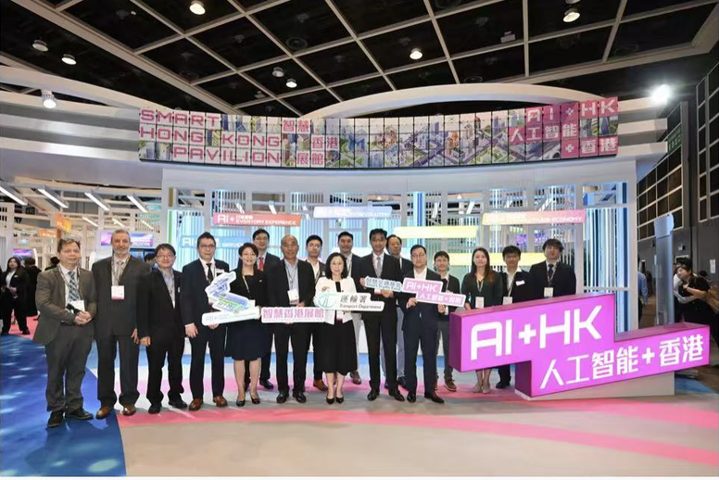
Use the founder’s accessible innovation and business settings for co-design, international communication, partner coordination, supervised demonstrations and work handoff. InnoSpire’s HK Tech 300 context and the cited PolyU facilities are real reference points, not endorsements of HSIMC. [S10–S12, S16–S18]
Use the founder’s Futian starting point and manufacturing relationships to specify, source, adapt and validate missing cables, NFC carriers, camera interfaces, mounts, fixtures and software interfaces. A supplied component becomes a contribution only when it meets the Work’s acceptance conditions.
Can a person in one location request a useful outcome that another participant can now deliver at a viable cost? Count accepted work, contribution and recurring usefulness—not logos, addresses or app installations.
EIGHT STARTING LOCATIONS
The founder confirms current practical access to all eight sites and identifies them as available starting locations. The working roles below are proposed. They are not eight already-operating MCP centres.
八处场所按创始人本轮确认的实际可接入条件登记。大学、科学园及其他机构名称用于说明场所,不代表机构已联合发起本项目。活动按预约与各场所适用条件安排;酒店房间改造仍是下一阶段事项。
HK-01
Pannex / Novel
Flat K, 6/F, Phase 1, Kwun Tong Industrial Centre, 472–484 Kwun Tong Road, Kowloon, Hong Kong
香港九龙观塘道472–484号,观塘工业中心一期6楼K室(6K)
Proposed role: Reference integration, sample work and repeatable device acceptance
First Work: One device + one NFC/vision task + a second operator repeats the result
Founder-confirmed access; address also appears on Pannex’s official site. [S13, S18]
HK-02
InnoSpire
8/F, United Centre, Admiralty, Hong Kong
香港金钟统一中心8楼
Proposed role: Partner coordination, accessible-work planning and demonstrations
First Work: One approved work brief and a named local supervisor
Founder-confirmed access. No additional street/unit number is inferred. [S18]
HK-03
University entrepreneurship setting
4/F, Jockey Club Innovation Tower, The Hong Kong Polytechnic University, Hung Hom, Hong Kong
香港理工大学赛马会创新楼4楼,InnoHub
Proposed role: Engineer/student replication, documentation and small-group evaluation
First Work: A new operator follows the release and completes the same bounded test
Founder-confirmed access; floor/building corroborated by PolyU. [S16, S18]
HK-04
Wan Chai collaboration setting
Room 2712, 27/F, Office Building, Convention and Exhibition Plaza, 1 Harbour Road, Wan Chai, Hong Kong
香港湾仔港湾道1号,会展广场办公大楼27楼2712室
Proposed role: Cross-border work workshops, partner demonstrations and handoff
First Work: One Hong Kong–Shenzhen work package with named deliverables and evidence
Founder-confirmed access; venue location corroborated by PolyU. [S17, S18]
HK-05
InnoSpire
Room 6, Unit 601, 6/F, Building 1E, No. 1 Science Park East Avenue, Hong Kong Science Park, Pak Shek Kok, N.T., Hong Kong
香港新界白石角香港科学园科技大道东1号,1E座6楼601单位6室
Proposed role: Assistive-device integration, phone/glasses acceptance and stakeholder sessions
First Work: One accessible interaction reviewed with its intended participants
Founder-confirmed access; address corroborated by InnoSpire. [S10, S18]
HK-06
User-facing physical entry
Shop 23, G/F, Mirador Mansion, Tsim Sha Tsui, Hong Kong
香港尖沙咀美丽都大厦地下23号铺
Proposed role: Assisted device activation and simple public-facing demonstration
First Work: One owner-controlled check/provision/test/exit journey by arrangement
Founder-confirmed access; proposed service not announced as open for walk-ins. [S18]
HK-07
Personal Reality Pod trial
Selected hotel rooms above the ground-floor shops, Mirador Mansion, Tsim Sha Tsui, Hong Kong; exact units not published
香港尖沙咀美丽都大厦内指定酒店房间;具体房号不公开
Proposed role: Planned limited adaptation for living/work-context and local-support trials
First Work: A reversible, bounded setup; room, safety and permitted-use conditions checked first
Founder-confirmed access; adaptation planned, not represented as completed or licensed construction. [S18]
SZ-01
Shenzhen integration and supply coordination
Unit 21B, Futian Foreign Trade Building, No. 23 Fuhua Road, Futian District, Shenzhen, Guangdong, China
中国广东省深圳市福田区福华路23号,福田外贸大厦21B
Proposed role: Adapters, components, fixtures, prototypes and supplier coordination
First Work: One missing capability specification becomes a tested contribution to a live Work
Founder-confirmed access and supplied address. [S18]
PREVIEW · DOWNLOAD · PRINT
The PDF contains the expanded TOC and launch evidence dossier. The full 30-chapter manuscript will be written and reviewed progressively.
Where the browser cannot display PDFs, use “Open PDF viewer” or read the complete HTML below.
Historical version: C0-001 TOC (retained) · Original foundation white paper · Machine-readable publication record · File hashes and release record
EXPANDED TABLE OF CONTENTS
Core Chapters 1–22 remain from C0-001. Parts VIII–IX add the three real-company pathways, founder evidence and launch locations. Chapter bodies are to be developed progressively.
30 chapters
PART I
1.1Consumer obsolescence versus remaining productive capability
1.2Dormant phones as distributed starting points—not a centrally owned inventory
1.3Existing stock, future retirement and alternative AI adoption scenarios
1.4From estimated devices to eligible nodes, active contributors and accepted work
2.1The shift from operating an app to requesting a real-world outcome
2.2Keeping human interfaces while making bounded functions available to AI
2.3A phone as a sensor, interface, computing resource and physical gateway
2.4Why useful GenAI participation need not mean running a large model on the phone
3.1The July 28, 2026 protocol shift and its implications for distributed capabilities
3.2Discovery, invocation and interoperability across independent implementations
3.3Stateless protocol interactions, persistent work identities and physical state
3.4Protocol conformance, device readiness and accepted delivery as separate milestones
PART II
4.1From physical-product engineering and modular systems to distributed capability production
4.2Research trails: multimodal AI, workspaces, capability routing, NFC, vision and Local Edge
4.3The 356,782 addressable Runtime reference identities: a substrate, not 356,782 executable services
4.4Connecting existing experiments through shared contracts, evidence and continuity—not starting another isolated platform
4.5Founder evidence and the three company-linked pathways are developed in Chapters 23–30
5.1A participant as capability contributor, work requester and beneficiary
5.2Task-critical requirements that are local, time-bound and individually specific
5.3Missing adapters, fixtures, methods, permissions, supervision and operating conditions
5.4Where catalogue supply, minimum production quantities and lead times cease to fit the work
5.5Complementing established supply chains with on-demand capability formation
6.1Ready for which Work, where, when and under whose Authority?
6.2Reuse, adapt, generate, manufacture, validate—or select a different path
6.3Deliver physically, transmit digitally or form the capability locally
6.4InstantReady → WorkShell → MakeHere → accepted production and AfterMake continuity
6.5Measuring time to usable capability—not promising instantaneous physical delivery
PART III
7.1Native phone capabilities: sensing, display, storage, connectivity and computation
7.2Reachable external capabilities: USB devices, NFC objects, sensors and authorized network services
7.3A composed node as a server to one layer and a client or host to another
7.4Phone → Local Hub → Personal Reality Pod → Team → Company → Community
7.5Accessible does not mean owned, available, safe or authorized
8.1MCP Tools: callable functions with explicit inputs, outputs and execution boundaries
8.2MCP Resources: URI-addressed data and context—not automatic ownership of physical assets
8.3Representing external equipment, places, materials and expertise through governed interfaces
8.4Capability manifests: provenance, current state, constraints, dependencies and acceptance evidence
8.5Selective discovery and contribution without publishing the whole device or every reachable resource
9.1Ownership, Android permissions, client identity and Work authorization as distinct relationships
9.2Granting a specific capability for a purpose, duration, usage limit and recipient
9.3Simple approval, visible activity, accessible revocation and controlled in-flight completion
9.4Separate maintenance privileges from normal MCP work access
9.5Local-only, private-group and selectively shared participation—without default global exposure
PART IV
10.1e-Person as working identity—not a phone, SIM, model session or replacement human
10.2Addressable Task Roles, assignments and scoped Human Supervision
10.3Continuity across models, locations, devices and participating organizations
10.4Replacing a device without losing work history—or silently transferring its authority
11.1Expressing the intended Reality Delta and the conditions for acceptance
11.2Resolving available capabilities before generating or sourcing new ones
11.3Turning missing conditions into bounded child work
11.4Parallel preparation, physical dependencies and explicit human decision points
11.5Preserving the work when a tool fails, a node disappears or a model changes
12.1e-Person-supported discovery, specification, preparation and execution coordination
12.2Bringing local contributors, manufacturers and professional supervisors into the same Work
12.3Forming a new tool or resource configuration rather than matching only existing listings
12.4Evidence → acceptance → reusable capability → the next productive opportunity
PART V
13.1Self-service, assisted and professional activation pathways
13.2Authorized activation stations and ATM-like commissioning kiosks
13.3Check ownership and device condition; preserve or erase data only as authorized
13.4Provision, bind, test, explain controls and issue an activation receipt
13.5A locally delivered service with reusable global engineering methods
14.1Installing a bounded MCP-ready application on a supported existing system
14.2Dedicated-device configuration where the operating system supports it
14.3Owner-authorized OS replacement or reflashing on eligible devices
14.4Hub-mediated participation when a phone cannot safely operate independently
14.5Recovery, rollback, unsupported-device decisions and responsible retirement
15.1Compatibility by tested capability, device configuration and operating conditions
15.2Battery condition, power, heat, mounting and sustained operation
15.3Combining external peripherals, network access and power without assuming compatibility
15.4Intermittent connectivity, retries, safe stopping and restart behaviour
15.5Signed updates, repair, vulnerability response and end-of-support decisions
PART VI
16.1Installation failure, recovery and a repeatable development path
16.2NFC writing and the distinction between user confirmation and independent readback
16.3USB-glasses preview, the photo-save failure and the remaining capture acceptance
16.4MCP battery access, one-tap approval and rejection of ungranted tools
16.5Human-tested revocation, outstanding security tests and lessons transferable to other devices
17.1Authorized sample observation and evidence-backed product information
17.2NFC-based physical-to-digital work handoff
17.3Local inspection, learning and supervised visual assistance
17.4For each template: intended outcome, required capabilities, consent, evidence and acceptance
17.5Progressing from a successful tool call to a result another person can use
18.1Another phone, another operator, another place—the same bounded Work
18.2Reference cohorts, compatibility matrices and explicit unsupported cases
18.3Active-grant, revocation, concurrency and protocol-migration test suites
18.4Distinguishing registry size, installations, active nodes and productive utilization
18.5An evidence register that preserves failures and prevents unearned readiness claims
PART VII
19.1Contributing device capability without surrendering the device or its data
19.2Attributing tools, software, methods, manufacturing, local work and supervision
19.3Access terms, usage measurement, acceptance, payment and dispute handling
19.4Commercial work, research and sponsorship as distinct participation paths
19.5Open interfaces and reusable knowledge alongside viable operating businesses
20.1Cost per accepted outcome—not value inferred from the number of idle phones
20.2Activation, models, connectivity, energy, maintenance and human support
20.3When local formation is preferable to remote supply—and when it is not
20.4Contribution incentives, uneven demand and sustainable local operation
20.5Demand-creation hypotheses: testing the loop from more usable capability to more useful work
21.1Lowering the entry cost for people, small businesses and local communities
21.2New work in adaptation, fabrication, supervision, maintenance and teaching
21.3Accessibility, language, jurisdiction and locally retained economic value
21.4Privacy, labour quality, power imbalances and the distribution of benefits
21.5Measuring productive reuse and environmental outcomes without assuming automatic benefits
22.1Freeze the accepted seed, close critical gaps and validate the first useful Work
22.2Recruit independent device owners, engineers, local hosts and work customers
22.3Pilot activation stations and repeatable commercial or sponsored delivery
22.4Connect phone nodes to HSIMC Runtime references, InstantReady and e-Person
22.5Extend beyond phones: new hardware, wearables and composed physical systems
22.6An invitation to contribute existing Reality—and help form what does not yet exist
22.7Begin from founder-accessible Hong Kong and Shenzhen sites, detailed in Chapter 29
PART VIII
23.1Existing visual-assistance products, HK Tech 300 context and the 2026 public mobility demonstration
23.2People with visual impairments as contributors, colleagues and customers—not only recipients of assistance
23.3Phone, smart glasses, accessible interfaces and permissioned human–AI collaboration
23.4Co-designed tasks, training, human supervision, fair compensation and outcome evidence
23.5First candidate: an accessible, supervised information task; mobility and employment claims tested separately
24.1Existing manufacturing, recycled-material product practice and frontline international customer relationships
24.2Founder-confirmed FIFA Women’s World Cup 2027 manufacturing and sales authorization within its licensed scope
24.3NFC as an entry to product information, assistance, delegated work and owner-controlled services
24.4Content after delivery: versioned provenance, accessibility, localization, support and revocation
24.5One object, successive useful services—without confusing certification, branding rights or a tap with consent
25.1Existing AI digital-employee and enterprise-agent capabilities as an industrial starting point
25.2HSIMC’s proposed contribution: local Reality, supervised delivery, permissioned interfaces and continuity
25.3e-Person as durable working identity; Kingsware capabilities as separately scoped service contributions
25.4Forming overseas operating capacity rather than merely translating software or adding a reseller
25.5Paid work packages, contribution evidence, commercial agreements and staged strategic investment—not free transformation
26.1Inclusion supplies new participants; physical products supply entrances; digital employees supply execution capabilities
26.2A composed example: accessible assistance requested through an NFC object and completed as supervised Work
26.3Shared contracts without assumed common ownership, management or exclusive dependence
26.4Measuring value for users, contributors, channel partners, service providers and the initiating infrastructure
26.5From one accepted result to reusable tools, resources and locally formed new demand
PART IX
27.1Benny Liao / Liao Yan: HSIMC founder and hands-on systems builder
27.2GB 16844—1997: named co-drafter; international alignment, interchangeability, testing and abnormal-condition safety
27.3Beijing 2015: Machine Vision and Industry 4.0; Nanjing 2016: service-robot development; Chengdu 2017: sensors and networked value
27.4Pannex frontline global product work and InnoSpire’s Strategic Execution Architect role
27.5Connecting the earlier questions to GenAI-native infrastructure—without treating history as present-day certification
28.1Hong Kong: accessible innovation, global communication, commercial relationships and supervised work delivery
28.2Shenzhen: component access, integration, fixtures, prototypes and capability-supply formation
28.3Cross-boundary Work: one accepted task with separately identified parties, contributions and responsibilities
28.4University and science-park settings as practical access contexts—not implied institutional endorsement
28.5Global value added through deployable capability and continuity, not geographical labels alone
29.1Kwun Tong 6K: Pannex / Novel integration and reference-work site
29.2Admiralty, PolyU campus, Wan Chai and Science Park: meetings, accessible research and engineering collaboration
29.3Mirador Mansion Shop 23 and selected hotel rooms: user-facing entry and a proposed Personal Reality Pod
29.4Futian Foreign Trade Building 21B: Shenzhen integration and supply coordination
29.5One site, one responsible host, one bounded Work, one acceptance record before any scaled service claim
30.1A first reference site and three company-linked work briefs, not eight simultaneous product rollouts
30.2Consent, equipment, operators, support, cost and local-use conditions before inviting users
30.3Activation and recovery trials at an authorized desk; ATM-like self-service remains a later configuration
30.4Publish evidence and repeat with another operator, device and site
30.5Progressive manuscript development: freeze the TOC, then release each evidence-backed chapter with its version history
APPENDICES & NEXT WRITING
A. Canonical terminology and protocol mapping
B. Evidence and source register
C. Reference node and capability contract
D. Authorized commissioning-station blueprint
E. Security and lifecycle acceptance matrix
F. Contributor and work-economics templates
G. Founder documentary register and publication permissions
H. Company relationship, licence and certification boundary register
I. Eight-site access, readiness and first-work register
Next editorial sequence: founder and theoretical foundation; three bounded company work briefs; site readiness and permissions; repeatable evidence from another operator and device. Publishing this outline does not initiate a product deployment or authorize remote use of any phone.
SOURCE REGISTER
PUBLIC HSIMC
Existing 196-page TP0 remains a separate preserved publication.
PUBLIC HSIMC
356,782 addressable reference identities; not an equivalent count of executable services.
PRIOR TOC SOURCE
5–10 billion estimate cited in C0-001; not a measured inventory of eligible MCP phones.
OFFICIAL PROTOCOL
The manuscript distinguishes this baseline from the Sony pilot’s 2025-11-25 implementation.
SUPPLIED DOCUMENT
Foreword names Liao Yan among the drafters. It is a lighting safety standard, not an AI standard.
SUPPLIED DOCUMENT
2nd Global Sensor Summit & China Internet of Things (IoT) Application Summit, 28 August 2015; talk: Machine Vision and Industry 4.0.
SUPPLIED DOCUMENT
International Summit of Service Robots Industry, 10 September 2016; program lists Liao Yan and an IoT/service-robot talk.
SUPPLIED DOCUMENT
4th Global Sensor Summit & China IoT Application Summit, 31 August–1 September 2017; program concerns blockchain, NB-IoT and Belt and Road value.
FOUNDER MATERIAL
Printed roles: Chief Digital Officer, Pannex Scien; Strategic Execution Architect, InnoSpire. Contact details are not republished.
COMPANY SOURCE
Visual-assistance app and smart glasses; Science Park office address.
UNIVERSITY SOURCE
Listed among Angel Fund start-ups; HK Tech 300 Angel Fund (2022). Listing is not endorsement of this white paper.
GOVERNMENT SOURCE
Documents smart-glasses assistance for visually impaired mobility at InnoEX. It does not validate this proposed infrastructure or employment outcomes.
COMPANY SOURCE
Company describes recycled-material standards, NFC gifts and international operations. Individual certification scope remains product- and transaction-specific.
FOUNDER-SUPPLIED CATALOGUE
Cover and pp.1–2 inspected from the earlier supplied 16-page catalogue. Founder confirms manufacture/sales authorization; the licence agreement and its schedules are not reproduced here.
COMPANY SOURCE
AI digital employees, enterprise agents and RPA-based solutions. New HSIMC work packages remain proposed, not signed commitments.
UNIVERSITY SOURCE
Official page locates the campus InnoHub on 4/F, Jockey Club Innovation Tower.
UNIVERSITY SOURCE
Official location: Room 2712, Convention and Exhibition Plaza, Office Building, 1 Harbour Road, Wan Chai.
FOUNDER-CONFIRMED
Current physical access is asserted by the founder. Working roles are proposed; room adaptation and hosted activities require their own readiness review.
HSIMC + USER ACCEPTANCE
User confirms active red Stop button and visible stopped receipt; not a claim that ADB-wide privileges or all adversarial cases are contained.
PUBLIC HSIMC
Part → capability → pod → team/company/community. Architectural framing remains HSIMC’s proposal.
PUBLIC HSIMC
Versioned Prompt, test, failure, correction, acceptance and continuation.