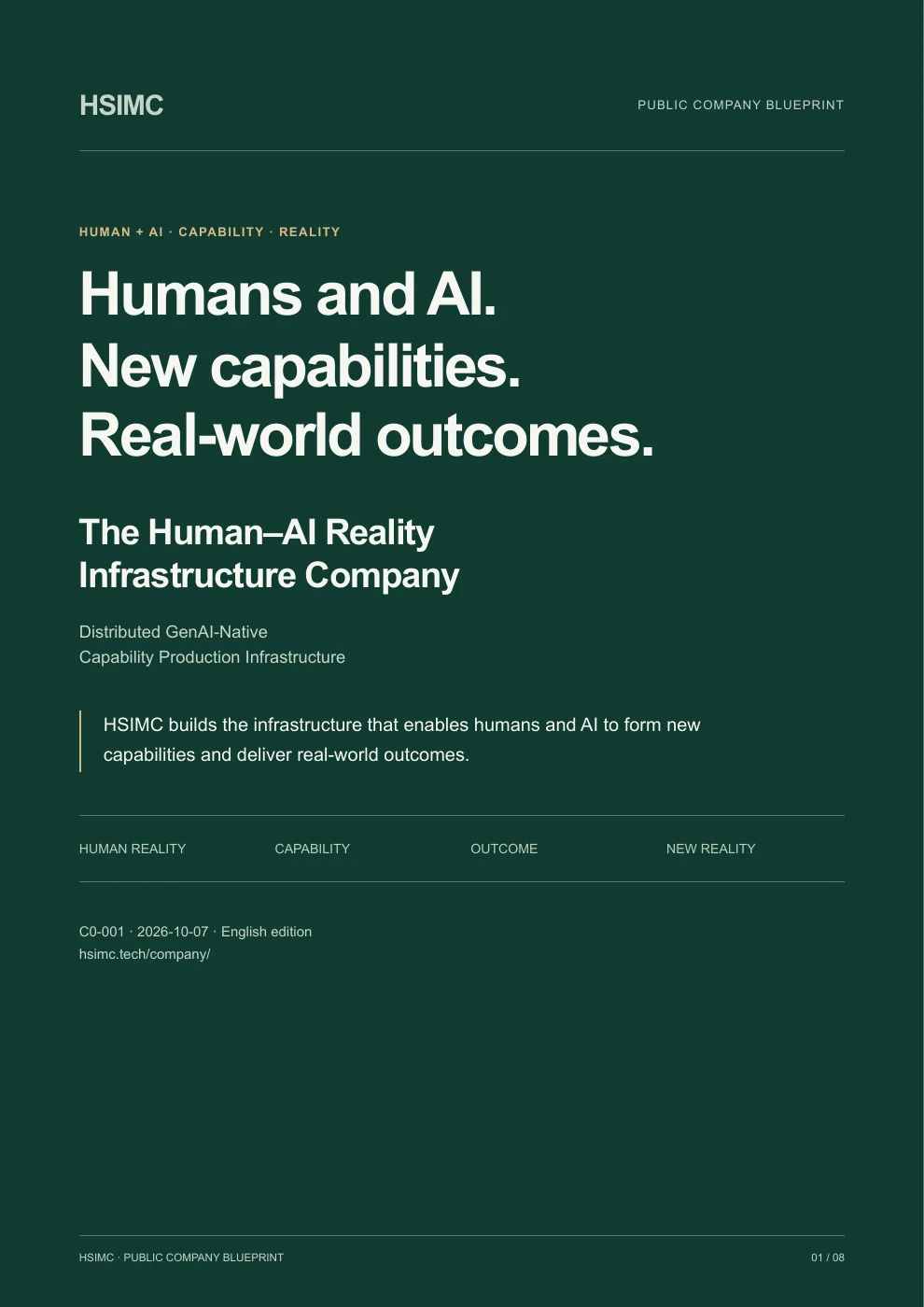
Humans and AI. New capabilities. Real-world outcomes.
The Human–AI Reality Infrastructure Company
Distributed GenAI-Native Capability Production Infrastructure
THE NAME. THE PURPOSE.
HSIMCHong Kong & Shenzhen Instant Manufacturing Corporation Limited
Rooted in two cities. Creating possibility, everywhere.
Hong Kong and Shenzhen are our starting point—not our boundary. Through Human–AI Reality Infrastructure, we connect people, knowledge, resources and real-world conditions across places and time.
“Instant Manufacturing” goes beyond making products: it means forming the conditions for new capabilities and new realities, where and when they are needed—turning local contributions into shared economic value and wider human benefit.
HSIMC builds the infrastructure that enables humans and AI to form new capabilities and deliver real-world outcomes.
We connect global intelligence, knowledge and industry capabilities with local spaces, devices, people and working conditions. The purpose is to strengthen cognition, perception and action—not simply generate more digital output.
Automation is one means, not the sole measure of value. Understanding a situation, living more independently and completing useful work are all meaningful outcomes. People remain the beneficiaries and decision-makers—not peripheral devices in an AI system.
02 / FROM INTENT TO OUTCOME
Start with human reality. Create the next reality.
A task starts with what a person or organization needs to change. Intelligence and on-site conditions are resolved together; the result is checked against that intent.
01
Human reality
Current understanding, environment and ability to act.
02
Intent → Work
Define the change and the work needed to achieve it.
03
Intelligence + local conditions
Bring reasoning, knowledge, tools, people and suitable space together.
04
WorkShell → Execution
Combine the capabilities and authority needed for this work.
05
Outcome + evidence
Check what happened and whether it meets the intended outcome.
06
New reality → Continue
Retain the outcome, reusable capability and a clear next step.
LLMs support reasoning and planning. Local nodes connect to the site. Neither a model response nor a successful protocol call is, by itself, proof of a completed real-world outcome.
03 / CAPABILITY ENHANCEMENT
Cognition, perception and action. Grounded in real conditions.
A capability is a usable combination matched to a particular task—not a list of devices.
01
Cognition & judgment
Capability
Models, expertise, retrievable work memory, computation and validation.
Conditions
Usable compute and power, relevant information, readable interfaces and appropriate data boundaries.
Outcome
Better understanding, comparison, decisions and reuse of experience.
02
Perception & situational understanding
Capability
Glasses, cameras, UWB, ToF, IMU and local signal processing.
Conditions
Mounting, orientation, lighting, time and coordinate association, and a permitted observation scope.
Outcome
Previously inaccessible or unclear information becomes usable understanding of the site.
03
Action & delivery
Capability
Software tools, device interfaces, audio, lighting, actuators and human operation.
Conditions
Energy, connectivity, materials, tools, site access, intervention and outcome checks.
Outcome
Authorized work completed with a result that can be verified.
A camera is not yet an inspection capability. A mount, suitable lighting, object placement, processing and a checking method may be just as necessary.
These are complementary relationships—not three names for the same product.
Persistent work identity
e-Person
Carries role relationships, capability references, work history and handovers. A model, mailbox or device can change without forcing permitted identity and history to start again.
Organizational work role
AI Employee
Binds an e-Person to an organization and a defined task or role, with explicit scope, resources, costs, supervision and validity. An account alone does not grant access.
Delegation and delivery
MyTrustee / 智受托
Organizes the client’s requested outcome, contact, supervision, exception handover and acceptance. Delivery can combine AI work identities, local people, remote experts and suppliers.
Supervised AI Work, Delivered Locally.
A person may have several purpose-specific e-Persons; an e-Person may hold several explicit roles. Data, authority and contributions do not automatically cross those role boundaries.
05 / WORK · LIVING · MOBILITY
InstantSpace. Where capability becomes possible.
InstantSpace = Boundary + State + Time. A space may be digital, physical or hybrid. Stable identity does not mean its condition, availability or authority remains unchanged.
InstantSpace
Where, when and under what conditions work can become possible.
InstantReady
Whether the conditions are sufficient for this task—and what is still missing.
WorkShell
The work-specific combination of capabilities, interfaces, people, control and evidence.
Runtime
Addressable identity, state and continuity for the relevant entities.
Work
A desk, bench or service cart can support sustained inspection, diagnosis or research. The work determines the physical form.
Living
Support finding, understanding, learning and communication. Autonomy matters; living space is not an office by default.
Mobility
Continue work across locations. Available capabilities change with motion, connection and environment.
Space is not a fourth parallel ability. It provides the conditions on which cognition, perception and action depend. When sensing occurs, where it is excluded and what remains local are part of those conditions.
Do not just find capability. Form what is missing.
Reuse what is suitable. Turn missing fixtures, interfaces, methods, environments or local support into explicit work. Design, fabrication, configuration and field service become part of capability production.
Identify the gap
Form the conditions
Install & verify
Retain reusable capability
Global intelligence. Local capability.
01
Move physical capability
Move people, equipment, materials or tools, retaining the conditions for installation, recovery and support at the destination.
02
Continue digital work
Transfer permitted models, methods, tasks, data and records. Destination compute and site conditions continue the work.
03
Form capability locally
Combine a capability blueprint with local resources; supply missing adapters, tools or support and validate the result at the destination.
Capability must become locally actionable. Methods can transfer; destination credentials, authority and acceptance do not transfer automatically.
07 / REALITY R&D
One architecture. A concrete reference pathway.
Reality R&D connects research, hardware, models and suppliers through shared capability descriptions, reference tools and evidence. It is a product family within HSIMC—not the whole company.
Capability formation & validation
Reality R&D
A shared path for distributed research and integration, from explained capability to simulation and site-specific validation.
The first edge reference node, with an Ubuntu 24.04 reference profile. It connects the work contract to local computation and device interfaces; it is not the only possible hardware.
A published, clickable map of 33 vendor-declared board objects. Explanation of an interface is distinct from current driver or physical execution readiness.
LLMs contribute reasoning; local nodes contribute on-site processing and interfaces; sensors observe; software and actuators act. MCP is the capability interface—not a substitute for work history, local conditions or authority.
The published browser reference bench uses labelled simulated data. Cloud reference, hybrid integration and physical nodes remain distinct evidence classes. University and supplier projects are applications under the product—not implied institutional endorsements or claims of production readiness.
08 / CONTRIBUTION & DELIVERY
Contribute to an outcome. Keep the contribution visible.
Knowledge, software, fixtures, power, devices, manufacturing, field service, supervision, channels and support can contribute to the same outcome. Attribution, pricing and settlement remain explicit.
01What improves for the person?
02What can now be done that was difficult before?
03Who made it possible—and can the capability be delivered again?
Resource consumption is not client value. Accounts, calls and equipment counts do not prove that useful work is complete.
Supervision with substance.
Define scope, competence, response arrangements, intervention and handover. Reuse valid authorizations within scope; reassess material changes. Supervision does not replace product, data, trade or professional responsibilities.
09 / PUBLICATIONS
Read, preview and share the public blueprint.
English and Chinese editions present the same company framework. Preview every page here or download the PDF for offline reading and sharing.
Bring a real need, the intended outcome and the conditions you already have. The next step is to define the work and the contributions it needs—not to assemble every participant and device in one place first.