HSIMCTHE HUMAN REALITY INFRASTRUCTURE COMPANY

REALITY R&D · PRODUCT 001 · HELPERBOARD T736

CLICK THE BOARD.
从板级接口理解能力。

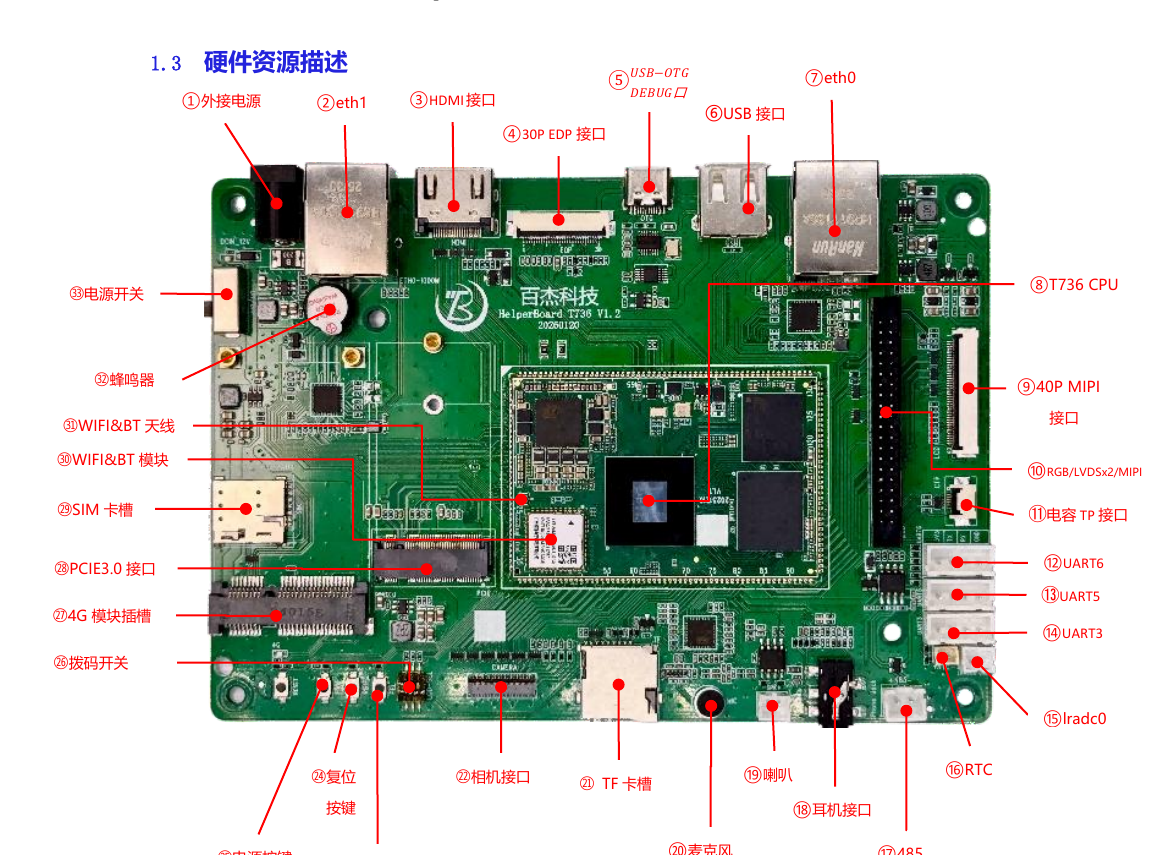
Turn a physical development board from a static hardware picture into an addressable capability map. Each numbered point explains what the vendor declares, how it may participate in a Runtime, and whether it is a candidate for future simulated input or execution.

第一阶段先把板上的电源、网络、显示、串口、相机、音频、扩展与控制对象讲清楚。第二阶段再在同一热点上加入仿真输入源与仿真执行器。

P0-003 · Capability explanation only. Clickability does not prove driver readiness, physical availability or execution Authority.

WHY ALLWINNER · WHY T736 · HSIMC UBUNTU REFERENCE PROFILE

Why this board became Reality R&D Product 001.

HSIMC starts with T736 for a practical reason: it combines meaningful local AI compute with unusually rich physical I/O, while sitting inside a Zhuhai–Shenzhen–Hong Kong engineering ecosystem that we can actually reach. The goal is not to declare one chip “the answer”, but to use one concrete, supportable edge platform to make the MCP-native R&D method real.

WHY ALLWINNER

A nearby SoC ecosystem for physical products.

Allwinner was founded in 2007 and is headquartered in Zhuhai, with R&D centres or branches including Shenzhen and Hong Kong. Its public portfolio spans industrial control, robotics, smart hardware, automotive and IoT—close to the kinds of physical Reality HSIMC needs to connect.

Allwinner official company profile ↗
WHY T736

Enough local AI, plus the interfaces needed to touch Reality.

The official T736 reference combines 2× Cortex-A76 + 6× Cortex-A55, PowerVR GPU, 3 TOPS NPU, PCIe / USB / dual GMAC, camera and multiple display paths. Allwinner positions it for industrial control, edge computing and robotics.

Allwinner official T736 page ↗
HSIMC REFERENCE PROFILE

One published software baseline: Ubuntu 24.04.

Allwinner's public chip page lists Android and Tina Linux. Our HelperBoard vendor also provides Ubuntu variants. For HSIMC Reality R&D Product 001, we deliberately publish only one reference software baseline—Ubuntu 24.04—to reduce cross-site integration variables and keep cloud, university, supplier and physical-node work reproducible.

HSIMC product decision · not an Allwinner software limitation
CPUDual-core Arm Cortex-A76 + hexa-core Arm Cortex-A55 · up to 2.0 GHz
MCURISC-V XuanTie E902
GPUImagination PowerVR BXM-4-64 MC1
NPU3 TOPS
Memory supportLPDDR4 / LPDDR4X / LPDDR5 · official T736MX-HN3 reference lists up to 16 GB DDR
CameraMIPI CSI · 2×4 + 2 lane · 24M@25fps reference specification
DisplayRGB ×2 · MIPI DSI ×2 · dual-link LVDS ×2 · E-ink · eDP 1.4b / DP 1.4
High-speed I/OPCIe 3.0 · USB 3.1 · USB 2.0 ×2 · SDIO 3.0 ×3 · GMAC ×2
Control / serialUART ×9 · TWI ×16 · SPI ×5 · PWM ×30 · LRADC ×1 · GPADC ×7
Industrial referenceOfficial product page lists −40°C to 85°C operating environment
Our HelperBoardVendor manual: 2G / 6G LPDDR5 (max 16G), 32 / 64GB UFS (max 1T), dual Gigabit Ethernet and the board interfaces mapped below
HSIMC softwareUbuntu 24.04 only for this reference product
Local AI headroomEnough CPU/GPU/NPU capability to move inference and decision loops toward the edge instead of requiring every observation to return to cloud compute.
Physical I/O densityNetwork, camera, serial, USB, PCIe, display, audio and control interfaces make one board useful for many Reality R&D experiments.
Reachable ecosystemZhuhai / Shenzhen / Hong Kong proximity matters for real supplier engineering, board support and eventual manufacturing—not just for a web demo.
One Linux baselineUbuntu 24.04 gives universities, suppliers, cloud tooling and local nodes one common operating target before hardware-specific differences are introduced.

Specification boundary. Allwinner's public T736 page currently describes the T736MX-HN3 reference and states that other T736-series submodels may differ. The board map below is based on the HelperBoard T736 V1.2 vendor manual. Chip-family specifications, board implementation and HSIMC's Ubuntu-only reference profile are intentionally kept as three separate layers.

HELPERBOARD T736 V1.2 · CLICKABLE CAPABILITY MAP

33 board objects become individually addressable explanations.

The background is taken from the vendor manual section “1.3 硬件资源描述”. Numbered markers are HSIMC interaction overlays. The manual is the source for connector names and basic declarations; HSIMC annotations describe only candidate capability roles and future simulation paths.

SOURCE · VENDOR DECLARATION CAPABILITY OBJECTS · 33 DRIVER READINESS · NOT INFERRED PHYSICAL T736 · NOT CLAIMED ONLINE AUTHORITY · NONE
HelperBoard T736 V1.2 hardware resource diagram with 33 red numbered interface labels

Loading capability dictionary…

FILTER THE BOARD BY CAPABILITY ROLE

One board becomes a set of capability domains.

CAPABILITY SUMMARY

The board is physical stock. Capability is the bounded, explainable unit.

NEXT LAYER · RESERVED, NOT IMPLEMENTED IN P0-003

The same hotspot will later carry simulation source and executor behavior.

Clickable ≠ driver-ready. Vendor declaration ≠ current Runtime readiness. Simulation candidate ≠ simulated. Executor candidate ≠ authorized physical action.

This public page is a capability explanation surface. It does not flash firmware, load drivers, switch power, access a camera, transmit serial data, energize audio outputs, create an e-Person or grant physical Authority.